Aiserveon
Choosing a deep learning server manufacturer in 2026 requires more than comparing GPU numbers. A powerful server can still disappoint when cooling fails, drivers conflict, or replacement parts arrive weeks late. Procurement teams should examine complete system design, including GPUs, CPUs, memory, networking, storage, power delivery, and rack density. Small details matter. A blocked airflow path can reduce performance during long training runs.
Jensen Huang, NVIDIA’s founder and CEO, said, “AI is going to eat software.” His statement reflects a larger shift. Hardware now supports fast-moving AI platforms, not isolated applications. Therefore, buyers should evaluate whether a manufacturer supports current frameworks, multi-node scaling, virtualization, and future accelerator upgrades. Verified benchmarks are useful, but they never tell the whole story. Ask for workload-specific results. Image training, language-model fine-tuning, and inference create different pressures.
Reliability should remain central. Check warranty terms, remote monitoring, on-site service, firmware management, and spare-part availability in your region. Review the manufacturer’s experience with high-density deployments. Speak with existing customers when possible. Their answers may reveal more than a polished brochure. Cost also deserves a wider view, including electricity, cooling, software support, and downtime. The cheapest quote may become expensive later. No shortlist is perfect. Even experienced teams can underestimate integration work. A careful deep learning server manufacturer should explain those risks clearly, rather than promise effortless performance.
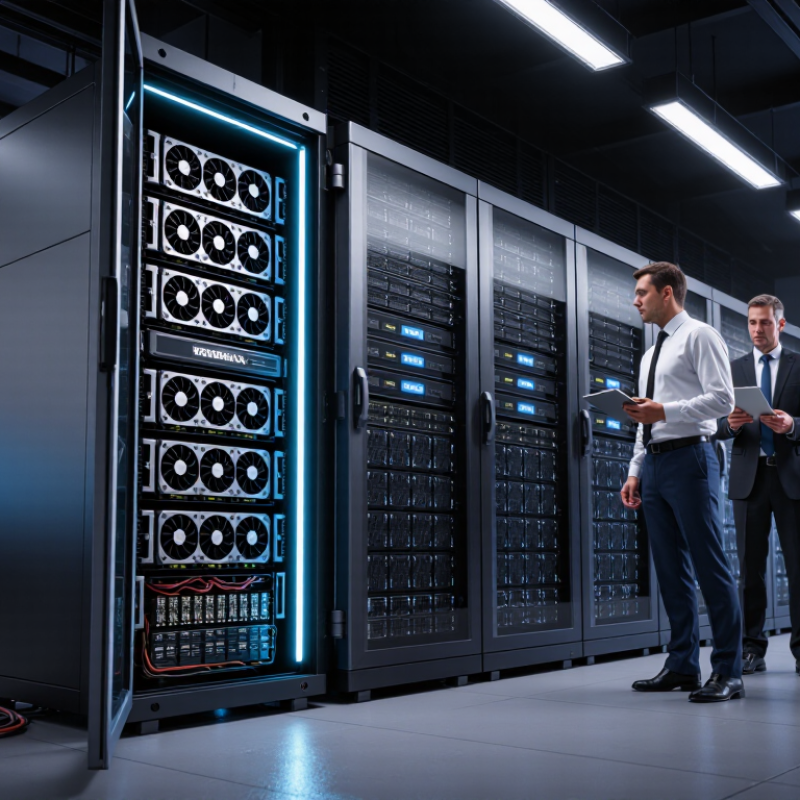
Begin with the workload, not the server catalogue. Identify model size, training frequency, dataset volume, and expected users. A vision model processing factory images needs different resources from a language model serving thousands of requests. Record input size, sequence length, batch size, and acceptable response time. Small details matter.
The Stanford AI Index Report 2025 states that training compute for notable models has doubled roughly every five months. That pace makes future capacity difficult to predict. Measure tokens per second, images per second, and time to checkpoint. Then test scaling across one, four, and eight accelerators. MLPerf Training results repeatedly show that theoretical accelerator speed does not guarantee proportional system performance. Network latency, storage throughput, and software maturity can limit expensive hardware.
Power and cooling also belong in the performance discussion. Uptime Institute’s Global Data Center Survey 2024 reported a global average annualized power usage effectiveness of about 1.56. Your facility may perform worse. Measure rack power, airflow, and thermal throttling during sustained workloads. Do not trust short benchmark runs alone. They can hide failures.
I would leave headroom for larger models, but not buy unlimited capacity. That is where planning becomes imperfect. A practical test uses your own data, deployment software, and monitoring tools. Ask for reproducible results, failure rates, service response times, and spare-part availability. The cheapest server may become costly when experiments wait overnight.
Choosing a deep learning server manufacturer in 2026 requires more than counting GPUs. Start with workload behavior. Large language model training needs high-throughput accelerators, while recommendation systems may favor stronger CPUs and larger memory capacity. In practical evaluations, measure tokens per second, time-to-train, power draw, and failure recovery. Peak benchmark scores can mislead.
GPU memory is often the first constraint. Select enough capacity for model weights, optimizer states, and batch growth. CPU cores should feed the accelerators without creating input pipelines delays. The Stanford AI Index 2025 reports that GPT-3.5-level inference costs fell from $20 to $0.07 per million tokens between November 2022 and October 2024. Lower inference costs make efficient memory and utilization more valuable than oversized hardware.
Interconnects deserve close inspection. Compare bandwidth, latency, topology, and support for collective operations across every GPU. A server with fast accelerators can still underperform when data crosses slow links. MLPerf Training results consistently show that scaling efficiency depends on communication, not compute alone. Memory bandwidth matters, too. The IEA’s Energy and AI report estimates data-center electricity use could reach about 945 TWh by 2030, compared with roughly 415 TWh in 2024. Ask manufacturers for measured performance per watt, not only theoretical specifications. I would also question my own test plan: one clean benchmark rarely represents months of mixed workloads. Validate with your datasets, thermal limits, and maintenance procedures.
A deep learning server manufacturer should be judged by operational evidence, not polished specifications. Uptime Institute’s 2024 Global Data Center Survey links many serious outages to power, cooling, and human error. Its findings reinforce one practical lesson: reliability is a process, not a component. Ask for failure-rate data, burn-in procedures, thermal testing records, and references from installations with similar workloads. Ask for proof. Not promises.
Support quality becomes visible during a failed accelerator, unstable firmware update, or delayed replacement part. Require a written service-level agreement covering response times, spare-part locations, escalation routes, and remote diagnostics. Check whether engineers can reproduce software and hardware faults together. A technically strong server can still become expensive downtime if support tickets sit unanswered. I would also test the support channel before signing. Send a difficult question. Measure the answer.
Lifecycle planning deserves equal attention. The Stanford AI Index 2025 reports that notable AI training compute has been doubling approximately every five months. A server that looks powerful today may face memory, networking, or power limits sooner than expected. Review upgrade paths, operating-system support, firmware policies, and component availability for at least five years. Confirm whether future accelerators, storage devices, and network cards can fit the existing chassis. This is where many evaluations become too optimistic. A spreadsheet may show compatibility, but actual rack power and cooling can disagree. Choose a manufacturer willing to document those constraints and admit them early.
Choosing a deep learning server manufacturer in 2026 requires more than comparing accelerator counts. Security and ownership costs often decide whether a promising cluster remains dependable.
In deployment reviews, I look for secure boot, hardware root of trust, signed firmware, and clear vulnerability response times. Ask how administrators isolate training jobs and protect model data in transit and at rest. Require audit logs showing access, changes, and failed login attempts. Vague answers deserve a second meeting.
Energy efficiency must be measured at the wall, not promised in a brochure. Request power readings during training, inference, and idle periods. High peak performance can still waste energy when memory remains underused. Check airflow design, fan control, liquid-cooling options, and facility compatibility. Ask for telemetry exports, not screenshots. Small details matter.
Build a five-year total cost model. Include purchase price, electricity, cooling, software support, spare parts, rack space, training, and planned downtime. Compare warranty terms with response and replacement commitments. Calculate delayed experiments, too; idle researchers are an expensive hidden cost. I once saw a model exclude cooling and technician time. It looked impressive. It was wrong.
Request references from organizations with similar workloads, not generic testimonials. Speak with operations staff. They can reveal firmware friction, noisy fans, and repair delays that sales documents omit. Test a small pilot before signing a large order. A pilot cannot predict everything, but it exposes uncomfortable assumptions early.
Choosing a deep learning server manufacturer in 2026 requires more than comparing processor counts. Compatibility must be verified against your models, frameworks, operating systems, and existing storage. Request a test unit or a controlled benchmark. Measure training time, memory usage, network latency, and thermal behavior under sustained workloads. A server that performs well for ten minutes may throttle after six hours.
Scalability deserves equal attention. Check whether the system supports additional accelerators, faster interconnects, larger memory, and redundant power modules. Ask for clear upgrade paths, not vague promises. Review firmware policies, driver support, warranty response times, and spare-part availability. Documentation matters. Engineers should find installation procedures, compatibility matrices, and failure-recovery steps without waiting for sales staff.
Procurement teams should also examine 2026 requirements for energy efficiency, cybersecurity, supply-chain transparency, accessibility, and data protection. Request power measurements at idle, normal load, and peak training. Confirm secure boot options, update controls, audit records, and component origins. Procurement templates can hide practical risks. A low purchase price may create higher cooling and maintenance costs later. That mistake is easy to make. I would also leave room for uncertainty, because benchmark results rarely match every production workload. Run a small pilot with real datasets, record the assumptions, and let technical, financial, and compliance reviewers challenge the final specification.
Start with your workload, not a product list. Record model size, dataset volume, batch size, and training frequency. Measure tokens or images processed per second. Also record acceptable response time. Small details matter.
Vision workloads may process large images, while language workloads handle long sequences and many requests. These patterns need different memory, accelerator, storage, and network resources. A single server design may not suit both.
Use your own datasets, models, deployment software, and monitoring tools. Test one, four, and eight accelerators when possible. Measure training time, memory usage, checkpoint time, and network latency. Short tests can mislead.
Hardware may throttle after extended operation. A system can look fast for ten minutes, then slow down after six hours. Check temperature, airflow, rack power, and failure rates. Measure reality.
Check support for more accelerators, larger memory, faster interconnects, and redundant power modules. Request written upgrade paths. Vague promises are risky. Your future model may grow faster than expected.
Engineers should receive installation guides, compatibility tables, firmware policies, and recovery procedures. Ask about response times, spare parts, and warranty handling. Waiting for sales staff wastes valuable experiment time.
Request power measurements during idle, normal load, and peak training. Examine rack capacity, airflow, and cooling costs. A low purchase price may create expensive operational problems later. That can hurt.
Confirm secure boot, controlled updates, audit records, component origins, data protection, and supply-chain transparency. Include technical, financial, and compliance reviewers. Run a small pilot before approval. Assumptions can fail.
Choosing the right deep learning server manufacturer in 2026 requires a structured evaluation of both technical capability and long-term business value. Start by defining your workloads, model sizes, training frequency, inference demands, and target performance. Then compare GPU and CPU capabilities, memory capacity, storage speed, and interconnect bandwidth to ensure the system can handle current tasks without creating bottlenecks. The best configuration should balance raw computing power with flexibility for different workloads.
You should also assess the manufacturer’s reliability, technical support, warranty coverage, upgrade options, and product lifecycle planning. Security features, energy efficiency, cooling design, and total ownership costs are equally important for sustainable operation. Before purchasing, verify compatibility with your software environment, data center infrastructure, management tools, and future expansion plans. Finally, confirm that the proposed solution meets relevant 2026 procurement, compliance, and sustainability requirements, allowing your organization to build a dependable, scalable, and cost-effective deep learning platform.
