Aiserveon Aiserveon

How to Choose a Top AI Computing Server Manufacturer in China?

Time:2026-09-22 Author:Sophia
0%

Choosing a top ai computing server manufacturer in China requires more than comparing prices or reading product brochures. The right partner should demonstrate practical experience with AI workloads, including model training, inference, scientific computing, and large-scale data processing. Ask for clear specifications, such as GPU models, memory capacity, PCIe design, power consumption, cooling methods, and network performance. A reliable manufacturer should explain these details without hiding behind vague technical language. Request benchmark results from workloads similar to yours. One impressive number is not enough.

Manufacturing evidence also matters. Review factory capabilities, quality-control procedures, component traceability, and testing records. If possible, arrange a factory visit or an independent inspection. Examine how engineers handle thermal testing, firmware updates, spare parts, and server failures. Strong after-sales support can protect your investment when a rack stops working at midnight. Check warranty terms, response times, remote assistance, and local service coverage before signing an agreement. Compliance with applicable safety, electromagnetic, environmental, and export requirements should be verified for your destination market.

No vendor is perfect. Our first assumption may be wrong. A lower price can conceal weaker support, while a famous brand may still miss a project’s specific needs. Compare several suppliers through a documented evaluation process. Score performance, reliability, delivery capacity, communication, and total ownership cost. Speak with real customers, not only sales representatives. The best decision usually comes from evidence collected over time, not a polished presentation. A trustworthy Chinese AI server partner should welcome detailed questions and admit practical limitations. That honesty is often more valuable than exaggerated promises.
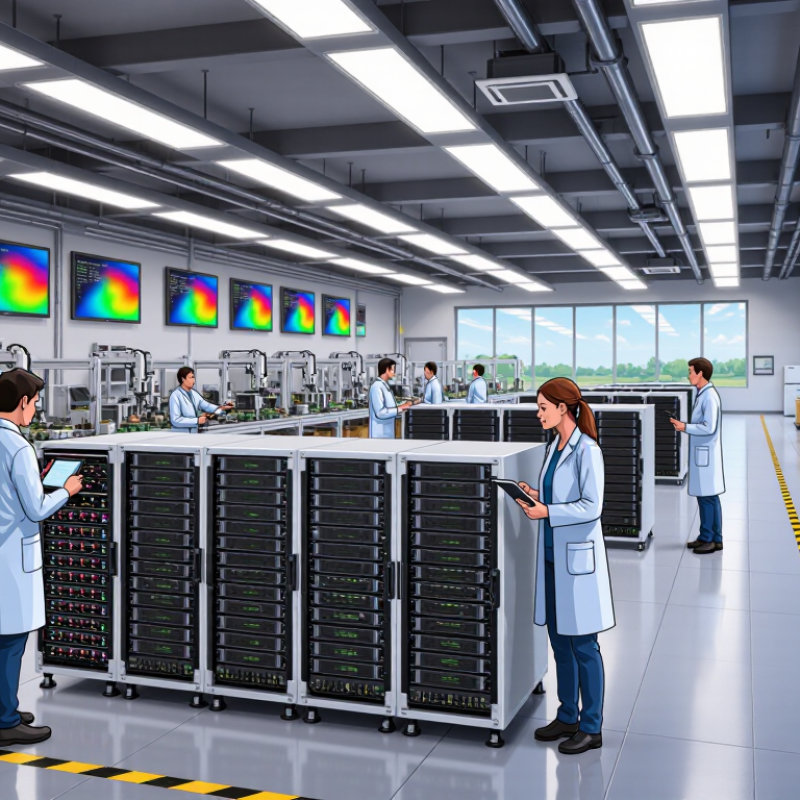
How to Choose a Top AI Computing Server Manufacturer in China?

Defining Your AI Computing Server Requirements

Choosing a top AI computing server manufacturer in China starts with defining your actual workload. Do not begin with a preferred GPU count. Identify model sizes, training frequency, inference latency, user volume, and expected growth. A vision model may need high accelerator density, while real-time language inference may depend more on memory capacity and network latency. Stanford’s AI Index 2024 reports that training compute for notable AI models has doubled roughly every five months. Your capacity plan should therefore include expansion space, not only today’s demand.

Power and cooling require equal attention. The International Energy Agency reported that global data centers used about 460 TWh of electricity in 2022, and consumption may exceed 1,000 TWh by 2026. Ask manufacturers for measured power data, thermal limits, rack density, and cooling compatibility. Check interconnect bandwidth, storage throughput, remote management, spare-part availability, and response times. Independent benchmark results are useful, but they may not match your software stack. That gap matters.

Tips:

Build a requirement sheet before requesting quotations. Include accelerator memory, host memory, network speed, storage endurance, rack power, warranty coverage, and deployment location. Request a pilot test with your own model and dataset. Small tests reveal uncomfortable details. A server can achieve excellent peak performance yet deliver disappointing production efficiency. I would also question optimistic three-year cost estimates; electricity, cooling, maintenance, and software integration are often underestimated. Leave room for revision. Requirements change faster than procurement documents.

Evaluating Chinese AI Server Manufacturers and Their Expertise

Choosing a top AI computing server manufacturer in China requires more than comparing prices. Evaluate engineering depth, delivery discipline, and support after installation. A capable manufacturer should explain GPU topology, CPU balance, memory bandwidth, networking, and storage without vague promises. Ask for test reports from workloads similar to yours. Real evidence matters. Look for measured throughput, power draw, thermal behavior, and failure rates under sustained workloads.

Experience appears in details. During technical discussions, ask how the team handles uneven GPU utilization, firmware conflicts, and cooling alarms. Request a sample rack layout, airflow plan, and maintenance procedure.

In China, manufacturing capability also includes component traceability, burn-in testing, and quality control across production batches. Verify whether engineers can support Chinese and international deployment requirements, including documentation, safety certifications, and secure remote service. Do not accept certificates as sole authority. Check issuing bodies and validity.

Authority grows through transparent references, not attractive brochures. Ask for customer cases with deployment scale, workload type, uptime, and support response times. A reliable supplier will define warranty limits, replacement procedures, spare-part availability, and escalation contacts before signing. It should also disclose lead times honestly. This is where evaluations become imperfect. One supplier may offer excellent hardware but weak software integration; another may provide strong support with slower delivery. Record these trade-offs in a scoring sheet, then test a small batch before expanding. The cheapest quotation can become expensive when idle GPUs, unstable drivers, or delayed repairs reduce usable capacity.

Comparing Hardware, Software, and Customization Capabilities

Choosing a top AI computing server manufacturer requires more than counting accelerators. Hardware must match workload, not marketing claims. Stanford’s AI Index 2024 reports that training compute for notable models has doubled roughly every five months. Memory capacity, interconnect bandwidth, storage speed, and thermal design therefore deserve equal attention. Ask for measured MLPerf results, power figures, and performance at your planned batch size.

Software capability is equally important. A reliable supplier should provide stable drivers, container images, monitoring tools, firmware updates, and technical support for major AI frameworks. Compatibility reduces deployment delays. The MLPerf Inference benchmark offers useful comparisons, but results can change with precision settings and workload design. That detail is often overlooked. Request reproducible test conditions, not only impressive headline numbers. A server that performs well in a laboratory may behave differently in a crowded rack.

Customization separates experienced manufacturers from assembly-only vendors. Evaluate options for liquid cooling, rack density, remote management, BIOS tuning, and storage layouts. The IEA’s Electricity 2024 report estimates data-centre electricity demand could more than double by 2026, exceeding 1,000 TWh. Efficient power delivery is no longer optional. Local spare parts and response procedures also matter. In field audits, documentation is sometimes weaker than the hardware. That weakness should be treated seriously. Ask for burn-in records, failure-rate data, upgrade paths, and clear ownership of software support before signing a contract.

How to Choose a Top AI Computing Server Manufacturer in China? - Comparing Hardware, Software, and Customization Capabilities
Evaluation Category Key Metric Industry Reference Data Strong Capability Indicator Recommended Verification Method Suggested Weight
Hardware Accelerator Support Support for current data-center accelerators with 80–192 GB of high-bandwidth memory per accelerator, depending on the selected platform. Validated configurations for 4–8 accelerators with documented thermal, power, and performance limits. Request official compatibility lists, system qualification records, and sustained-load test reports. 15%
Hardware Host CPU and Memory Dual-socket systems commonly support 32–128 CPU cores and approximately 512 GB–4 TB of system memory. Balanced CPU-to-accelerator configuration with adequate PCIe lanes, memory bandwidth, and NUMA tuning. Review CPU model, core count, DIMM population guide, memory speed, and NUMA topology. 10%
Hardware High-Speed Interconnect PCIe 5.0 x16 provides approximately 63 GB/s of theoretical one-way bandwidth; cluster networks may use 100, 200, or 400 Gb/s Ethernet or InfiniBand-class links. Low-latency accelerator-to-accelerator and node-to-node communication with a documented topology. Check topology diagrams, bandwidth tests, latency results, and collective-communication benchmarks. 12%
Hardware Power and Cooling Multi-accelerator servers often require roughly 3–10 kW per node; dense racks can exceed 30 kW and may require liquid cooling. Accurate power-budgeting tools, hot-spot analysis, redundant power options, and air or liquid-cooling designs. Request maximum-load power data, inlet-temperature limits, cooling diagrams, and facility requirements. 10%
Hardware Storage and Data Throughput AI training nodes commonly combine local NVMe storage with shared storage; PCIe 4.0/5.0 NVMe drives can provide several GB/s of sequential throughput per drive. Dedicated data paths for operating system, datasets, checkpoints, and cache, with scalable NVMe or shared-storage integration. Review drive configuration, RAID or erasure-coding options, filesystem compatibility, and measured read/write results. 7%
Software Operating System and Driver Compatibility Production AI environments generally require a supported Linux distribution, accelerator drivers, firmware, container runtime, and a stable update policy. Documented software matrix covering operating systems, drivers, firmware, containers, and accelerator libraries. Ask for version matrices, release notes, lifecycle policy, and rollback procedures. 10%
Software AI Framework and Container Support Common workloads use Python-based frameworks, containerized services, orchestration platforms, and distributed-training libraries. Pre-tested images for training, inference, fine-tuning, monitoring, and multi-node deployment. Request reproducible deployment scripts, container images, framework versions, and sample workload results. 8%
Software Management and Monitoring Enterprise systems typically require remote management, hardware health monitoring, event logging, and integration with centralized management tools. Out-of-band management, telemetry APIs, alerting, audit logs, and role-based access control. Review management screenshots, API documentation, security controls, and monitoring integration tests. 8%
Customization Configuration Flexibility Common customization areas include accelerator quantity, CPU and memory capacity, storage, networking, chassis size, power supplies, and cooling. Modular bill of materials with engineering validation rather than simple component substitution. Request a sample configuration worksheet, qualification checklist, and engineering change process. 7%
Customization Rack Integration Deployment may require standard rack units, redundant power distribution, network uplinks, cable plans, and compatibility with air or liquid cooling. Complete rack-level design including power, cooling, network, cabling, and installation documentation. Evaluate rack elevation drawings, power calculations, cable schedules, and site-survey procedures. 5%
Reliability Validation and Burn-In Testing AI servers should be tested under sustained compute, memory, storage, network, and thermal loads before shipment. Standardized burn-in tests with recorded results, failure tracking, and component traceability. Request factory acceptance test templates, stress-test duration, test thresholds, and serial-number traceability. 4%
Service Warranty and Technical Support Enterprise deployments typically require defined response times, spare-parts availability, remote diagnosis, and on-site service options. Clear service-level commitments, regional support coverage, escalation paths, and critical-component replacement plans. Review warranty terms, response-time targets, spare-parts locations, and support case procedures. 4%
Scoring guidance: Rate each criterion from 1 to 5 based on documented evidence, multiply by the suggested weight, and compare the weighted totals. The reference values are industry-oriented ranges rather than specifications for any particular manufacturer or brand.

Checking Certifications, Quality Control, and Technical Support

How to Choose a Top AI Computing Server Manufacturer in China?

Certification is the first filter, not the final decision. Check ISO 9001 for quality management, ISO/IEC 27001 for information security, and applicable CE, RoHS, or CCC documentation. Verify certificate numbers with the issuing bodies. Documents can be outdated. That matters.

A serious manufacturer should show traceable component records, incoming inspection results, and burn-in procedures. Ask for thermal cycling, power-load, memory, and GPU stability test data. Factory quality teams should record serial numbers, firmware versions, and failure rates. IDC’s Worldwide AI and Generative AI Spending Guide forecasts global AI spending above 632 billion dollars by 2028. This growth will pressure suppliers to deliver reliable systems, not impressive brochures. A practical trial order is safer than a large first purchase. Request your own workload test, including sustained inference and high-temperature operation.

Technical support deserves equal attention. Uptime Institute’s 2024 Global Data Center Survey reported that 53% of respondents experienced an outage during the previous three years. Even a short failure can interrupt model training and scheduled services. Ask whether engineers provide 24/7 response, remote diagnostics, spare-parts coverage, and clear escalation times. Review the service-level agreement carefully. It should define replacement windows, firmware assistance, and onsite options. Do not accept “lifetime support” without measurable terms. No checklist is perfect. I would also interview two existing customers and inspect one deployed system, because factory confidence can hide field problems.

How to Choose a Top AI Computing Server Manufacturer in China?

Certification milestones to verify when reviewing compliance, quality control, and technical support capabilities

The publication year indicates when each internationally recognized standard or regulation was first introduced. Certifications should be checked for validity, scope, issuing body, and relevance to server manufacturing, while quality-control records and technical-support service levels should be assessed separately.

Assessing Pricing, Delivery, and Long-Term Partnership Potential

How to Choose a Top AI Computing Server Manufacturer in China?
Assessing Pricing, Delivery, and Long-Term Partnership Potential

Price should be measured beyond the invoice. IDC forecasts global AI infrastructure spending will reach about $154 billion in 2025. Request a complete bill of materials, including GPUs, networking, cooling, warranties, and installation. Compare performance per dollar, not only the server’s purchase price. A cheaper configuration may consume more electricity or require costly upgrades. That matters.

Delivery reliability needs evidence. Ask for component availability, production schedules, factory testing, and shipment milestones. Require serial-number tracking and acceptance testing before deployment. The Uptime Institute reported that 55% of surveyed data center operators experienced an outage during the previous three years. Delays and weak testing can multiply operational risk. Get everything documented.

Partnership potential is harder to measure. Evaluate engineering response times, spare-parts locations, firmware support, and escalation procedures. IDC’s infrastructure outlook shows sustained AI demand, so future expansion should be planned during the first order. Ask whether the manufacturer can support rack integration, liquid cooling, and changing accelerator architectures. Practical experience matters here. However, no supplier is perfect. A polished factory visit can hide slow service after payment. Run a small pilot, measure delivery accuracy, power draw, thermal stability, and support quality. Then negotiate a longer agreement using those results, not optimistic promises.

FAQS

How should I define my AI server requirements?

Start with model size, training frequency, inference latency, user volume, and growth plans. Do not choose by accelerator count alone. A vision workload may need dense accelerators. Real-time language inference may need more memory and faster networking. Leave expansion space.

Which technical specifications deserve close attention?

Review accelerator memory, host memory, network speed, storage throughput, and storage endurance. Check GPU topology and memory bandwidth. Also assess rack power, cooling compatibility, remote management, and spare-part availability. Small specification gaps can become expensive later.

Why should power and cooling affect the purchasing decision?

High-density servers can produce substantial heat and consume significant electricity. Request measured power data, thermal limits, airflow plans, and rack-density information. Confirm compatibility with your facility. Peak performance means little if the system overheats.

Should I trust independent benchmark results?

Use them as references, not final proof. Benchmarks may use different software, datasets, drivers, or networking settings. Request testing with your own model and representative data. Small pilot tests reveal uncomfortable details.

How can I evaluate a manufacturer’s engineering expertise?

Ask engineers to explain accelerator topology, CPU balance, memory bandwidth, networking, and storage clearly. Discuss uneven accelerator utilization, firmware conflicts, and cooling alarms. Request sustained workload data, power draw, thermal behavior, and failure rates. Vague answers are warning signs.

What evidence should a manufacturer provide?

Request similar customer cases, deployment scale, workload type, uptime, and support response times. Review burn-in procedures, component traceability, and production quality controls. Certificates help, but verify their issuing bodies and validity.

What support details should be confirmed before signing?

Confirm warranty limits, replacement procedures, spare-part stock, escalation contacts, and lead times. Ask about secure remote service and technical documentation. Support may be strong but slower than expected. Record that trade-off honestly.

How can I compare quotations fairly?

Build a scoring sheet covering performance, power, cooling, delivery, support, integration, and maintenance. Include electricity and software costs. Three-year estimates often look too optimistic. Idle accelerators and delayed repairs can quietly increase total cost.

Is the cheapest server usually the best choice?

Not necessarily. A low quotation may hide unstable drivers, weak integration, or limited spare parts. A more expensive system may deliver better usable capacity. Still, expensive hardware is not automatically reliable. Test a small batch before expanding.

How should requirements change during procurement?

Keep the requirement sheet flexible. AI workloads, user demand, and software environments change quickly. Recheck assumptions after pilot testing. Leave room for revision. The original plan may be wrong.

Conclusion

Choosing the right ai computing server manufacturer in China begins with clearly defining your project requirements, including processing performance, GPU capacity, storage, networking, energy efficiency, and scalability. A suitable supplier should demonstrate strong expertise in AI infrastructure and provide hardware configurations, software compatibility, and customization options that match your workloads. It is also important to evaluate product reliability through certifications, quality-control procedures, testing standards, and transparent manufacturing practices.

Beyond technical specifications, assess the manufacturer’s technical support, maintenance services, response times, and ability to assist with system integration. Pricing should be considered together with delivery schedules, warranty terms, spare-parts availability, and total cost of ownership rather than as the only deciding factor. Finally, look for a partner with clear communication, stable production capacity, and a willingness to support future upgrades. A thorough comparison of these factors can help you select a dependable supplier and build a long-term AI computing infrastructure strategy.

Sophia

Sophia

Sophia is a dedicated marketing professional with an exceptional depth of knowledge about her company's products and services. With a keen understanding of market trends and customer needs, she crafts insightful blog posts that not only inform but also engage readers, enriching the company’s online......